


Quasi Three Dimensional Flow Duct Fan
A quasi three dimensional flow duct fan is an advanced aerodynamic device designed to generate thrust or airflow within a confined, carefully shaped passage. Unlike a simple axial fan, this configuration is based on a quasi‑three‑dimensional (Q3D) flow concept, which combines the analytical simplicity of two‑dimensional blade‑to‑blade calculations with corrections that account for three‑dimensional effects such as radial flow, secondary flows, and end‑wall boundary layers.The duct typically consists of an inlet diffuser, a rotor section, an optional stator section, and an outlet diffuser or nozzle. The rotor blades are arranged around a hub and enclosed by an outer shroud, forming an annular passage. The term “quasi three dimensional” refers to the design and analysis method in which the flow is solved on multiple spanwise sections, from hub to tip, assuming locally two‑dimensional flow on each section while enforcing radial equilibrium across the radius. This approach captures the variation of velocity, pressure, and incidence along the blade height without requiring a fully three‑dimensional numerical solution.Aerodynamic design begins with the specification of mass flow rate, total pressure rise, rotational speed, and geometric constraints. From these inputs, designers determine the radial distribution of flow parameters, including swirl velocity and static pressure. Blade sections are then defined at several radial locations using airfoil profiles tailored for the local incidence and Mach number. The chord, camber, and stagger angles vary with radius to maintain near‑optimal loading and to minimize losses from shock formation, separation, and tip leakage.The duct itself plays a crucial role in performance. By surrounding the rotor and any downstream stator with a contoured casing, tip vortex strength is reduced and the effective pressure rise per stage can be increased. The duct contour is usually shaped to manage diffusion and acceleration, preventing boundary‑layer separation on the walls. End‑wall contouring and the use of fillets at hub and casing junctions can further control secondary flows that arise from the interaction of pressure gradients and boundary layers.In a quasi three dimensional design framework, computational tools often combine meridional flow analysis, blade‑to‑blade flow solutions, and boundary‑layer models. Meridional analysis determines the overall streamline pattern from inlet to outlet in the r–z plane, including radius changes and area variations. Blade‑to‑blade calculations on multiple circumferential planes yield detailed pressure and velocity distributions around each blade section. Radial equilibrium equations link these planes, ensuring that the spanwise distribution of flow variables is consistent with conservation laws and centrifugal forces.This methodology provides a balance between accuracy and computational efficiency. It enables rapid iteration on blade shape, solidity, and stagger angles, as well as on duct geometry, to achieve targets for efficiency, pressure ratio, and noise. The resulting quasi three dimensional flow duct fan can be configured for applications such as propulsion, ventilation, and cooling where compactness, controlled noise, and high aerodynamic efficiency are required, particularly in regimes where compressibility and three‑dimensional flow effects cannot be neglected.
Products
Category:
-
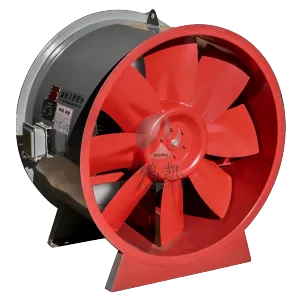
Compact SWF Mixed Flow Ventilation Fan for Duct Pressurization Systems
Category: FansBrowse number: 12Number:Release time: 2026-02-10 11:10:35The SWF Mixed Flow Ventilation Fan is a high-performance inline duct ventilation unit engineered using advanced CAD multi-objective optimization and quasi-three-dimensional flow theory, applying the meridional acceleration principle to achieve a pressure output higher than conventional axial fans of the same machine number while delivering airflow volume exceeding centrifugal fans of equivalent size — all within a body that is approximately 30 percent more compact than either alternative at the same duty point. Built around a direct-drive motor and a conically hubbed, twisted-blade impeller with internal fixed guide vanes that recover rotational exit kinetic energy as additional static pressure, the SWF Mixed Flow Ventilation Fan operates across a broad high-efficiency zone covering rated duty point ±20 percent, reducing sensitivity to real-world system resistance variation and ensuring consistent delivered performance across the full installed service life. Available in single-speed, dual-speed, and variable frequency configurations from 25 Hz to 50 Hz stepless control, with standard Q235 carbon steel construction and optional stainless steel 304/316, glass fiber reinforced plastic, acoustic silencer, rooftop, and explosion-proof variants, the Energy Saving Mixed Flow Blower covers airflow from under 1,000 to over 100,000 m³/h and full pressure from 54 to over 1,300 Pa across machine numbers from No.2.5 to No.12. Manufactured by Dezhou Pengkai Air Conditioning Equipment Co., Ltd. and supplied to HVAC system integrators, building contractors, mechanical and electrical consultants, and equipment distributors across Southeast Asia and global markets.
News
Category:
No search results found!
Case
Category:
No search results found!
Video
Category:
No search results found!
Download
Category:
No search results found!
Job
Category:
No search results found!
Featured Products
No search results found!



 Phone
Phone